What happens the moment you type your password at an exchange login: are you stepping into a custodial walled garden, a Web3 gateway, or something in between? That single question reframes how traders should choose and use an OKX account in 2026. OKX is no longer just a matching engine; it is a hybrid platform combining a centralized exchange, a self‑custodial Web3 wallet, an NFT marketplace, DeFi aggregation, and derivatives trading. Each of those pieces changes the attack surface, the economic trade‑offs, and the user decisions you must make before you log in and trade from the United States.
This comparison piece lays out the practical differences between using OKX as a traditional CEX account versus an OKX Web3/non‑custodial wallet session, draws operational trade‑offs for spot, margin, and derivatives traders, and gives decision heuristics you can reuse. I emphasize mechanisms (how custody, login security, and cross‑chain liquidity actually work), limits you must watch for, and what signals would change the calculus. If you trade from the US, this should sharpen one concrete mental model: custody is a spectrum, not a switch.
Two Modes: Custodial CEX Account vs Non‑Custodial Web3 Wallet
At its core, OKX offers two operational profiles that matter for login, security, and what you can do after signing in. The custodial CEX account is the traditional model: you open an account, complete KYC (identity verification with ID and liveness check), and deposit assets that OKX holds on your behalf. The non‑custodial Web3 wallet model gives you a seed phrase and private keys; OKX provides an interface and integrations (including Ledger/Trezor support) but does not control those keys.
Mechanisms that differentiate them:
- Custody and risk: CEX custody shifts counterparty and operational risk onto OKX; most assets (over 95%) are stored in air‑gapped, multi‑sig cold wallets, and OKX publishes Proof of Reserves so you can verify on‑chain backing. Non‑custodial wallets shift custody risk onto you — losing a seed phrase or falling for a phishing site can be permanent.
- Login and account protection: Both modes use strong engineering—military‑grade encryption and AI‑driven threat detection—but the live account model also requires mandatory 2FA (SMS, Google Authenticator, or biometrics). For the Web3 wallet, biometric unlocking on the mobile app is convenient but does not replace safe seed‑phrase handling.
- Regulatory and access constraints: Creating a custodial account requires KYC to meet AML obligations; non‑custodial wallets generally do not. That matters practically: custodial accounts enable derivatives and margin trading, while a pure Web3 wallet primarily enables DeFi interactions and cross‑chain swaps through OKX’s DEX aggregator.
What Each Mode Lets You Do — and Where It Breaks
If you want to buy Bitcoin quickly, use debit/credit, or access futures and options with leverage, the custodial route is the straightforward choice. OKX supports spot and margin trading (up to 10x for margin) and advanced derivatives including perpetuals and quarterly futures (up to 125x on some products). The exchange side also provides staking, flexible and fixed lock‑up options with auto‑compounding, and an NFT marketplace integrated into the same UX.
But there are trade‑offs. Derivatives amplify market risk; slippage and liquidity shortfalls can create huge losses on low‑volume assets. Custodial accounts mitigate private‑key loss but add counterparty and withdrawal‑approval dependencies; cold storage protects most funds but not funds held in hot wallets used for trading and fiat rails. Proof of Reserves improves transparency but is not a panacea: PoR shows backing at a point in time and requires correct, auditable linkage between user balances and on‑chain proofs.
By contrast, the Web3 wallet model is optimized for cross‑chain DeFi activity: OKX supports 130+ native blockchains and an aggregator that sources liquidity from big DEXs like Uniswap. That improves swap routing and can reduce slippage for some trades. However, interacting with DeFi and on‑chain contracts exposes users to smart contract risks and exploits. The non‑custodial route also makes recovery difficult — lose your seed phrase and the assets are irretrievable.
Login Best Practices and a Reality Check for US Traders
Login is the first operational line of defense. OKX’s mandatory 2FA and AI threat detection lower account takeover risk, but common failure points remain: reused passwords, SMS 2FA vulnerabilities, and phishing. For US traders I recommend this layered heuristic: hardware keys for high balances (use Ledger/Trezor integrations), Google Authenticator rather than SMS, and a dedicated email for exchange interactions. If you maintain a Web3 wallet, store the seed phrase offline in multiple secure locations and use a hardware wallet for large or long‑term holdings.
Another practical limit: U.S. regulatory constraints shape product availability. Some derivatives or token listings available globally may be restricted for US users; the KYC step is obligatory for most custodial services, and withdrawal/transfer windows can be constrained by compliance reviews. Plan, don’t assume instant access during volatile markets.
Decision Heuristics: Which OKX Path Fits Your Goals?
Make this checklist your quick heuristic:
- If you need fiat on‑ramps, instant exchange market access, or derivatives: custodial OKX account after KYC.
- If your priority is direct control of private keys, DeFi composability, and cross‑chain swaps: non‑custodial Web3 wallet plus hardware wallet for high value.
- If you value a mixed workflow (trade on CEX; occasionally interact with DeFi), use both but segregate funds: keep trading working capital in the custodial account and store long‑term positions in the non‑custodial wallet or cold storage.
One non‑obvious insight: using both modes within the same ecosystem reduces cognitive load (single interface, shared UX) but raises phishing risk because attackers can mimic the exchange’s consistent brand across both custody models. Treat any external signing request with skepticism and confirm contract addresses when bridging or using DeFi.
Operational Trade‑Offs for Active Traders
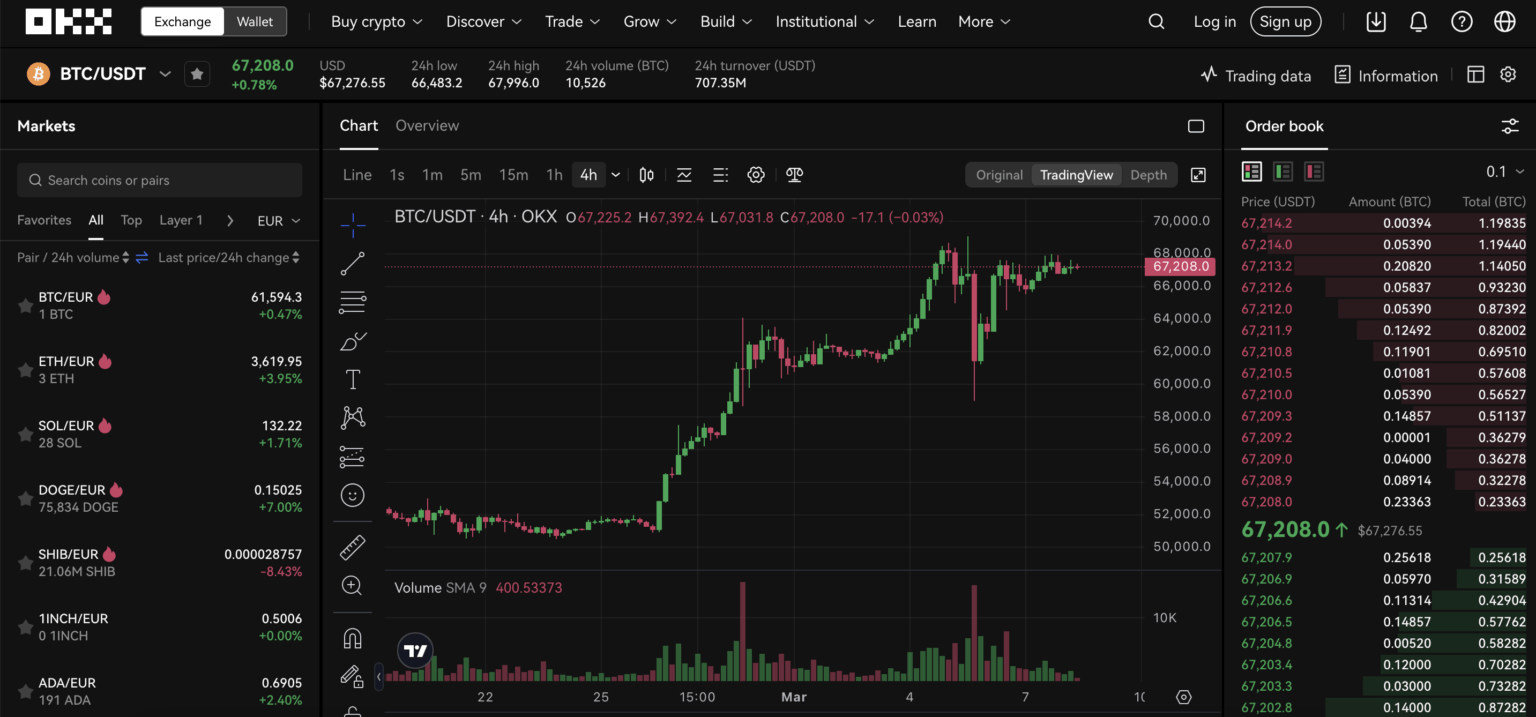
Active traders should weigh latency, liquidity, and capital efficiency. The OKX web and mobile platforms offer advanced charting and mobile biometric login for speed; the exchange’s order books aggregate liquidity for spot and futures. Using margin and leverage increases return potential but compounds the slippage and liquidation mechanisms — be explicit about maintenance margins and how cross‑margin may pull multiple positions into liquidation.
For cross‑chain strategies and yield farming, the DEX aggregator reduces manual routing work and can lower fees, but on‑chain gas and failed transactions consume capital. Auto‑compounding staking simplifies yield capture, yet lock‑up staking reduces liquidity — a known trade‑off between yield and optionality.
What to Watch Next (Signals That Should Change Your Strategy)
Monitor three classes of signals: protocol and security signals (proof of reserves updates, cold‑wallet audits, major exploit reports), regulatory signals (US policy shifts affecting derivatives or stablecoin rules), and market liquidity signals (widening bid‑ask spreads, rising funding rates). Recent app positioning—OKX promoting itself as a “new money app” to a global base of 100+ million users—matters only insofar as growth increases regulatory scrutiny and platform load during market stress. If any of these signals trend material, reevaluate custody split and withdrawal plans.
If you want to start or re‑enter the platform safely, use this small operational step: verify the exact login page and use the official OKX app or browser bookmark, then enable 2FA and link a hardware wallet for non‑custodial assets. For a quick login walkthrough or to check the current sign‑in flow, see this resource: okx sign in.
FAQ
Can I use OKX derivatives from the US?
Possibly, but availability depends on jurisdictional rules and KYC status. OKX offers futures and options globally, including high‑leverage products, but some instruments or leverage levels may be restricted for US accounts. Always check the product page after KYC and confirm margin rules before trading.
Which is safer: keeping Bitcoin in OKX or in my Web3 wallet?
“Safer” depends on the risk you want to avoid. Custodial OKX keeps most assets in multi‑sig cold storage and offers operational protections and PoR transparency; this reduces key‑loss risk but introduces counterparty and withdrawal risks. A self‑custodial wallet puts you in control of your private keys—removing counterparty risk—but makes you solely responsible for backup and protection. Use a hardware wallet plus offline seed storage if you prioritize self‑custody for larger holdings.
What if I lose access to my OKX account login?
For custodial accounts, follow OKX’s account recovery process; because KYC is required, recovery will involve identity verification. For non‑custodial wallets, losing your seed phrase typically means permanent loss. That asymmetric reality is why segregation of funds and hardware wallet use are standard recommended practices.
Does Proof of Reserves mean OKX cannot fail?
No. Proof of Reserves increases transparency about on‑chain backing at a snapshot in time but does not eliminate operational, legal, or business failures. PoR is a helpful signal, not an absolute guarantee. Consider it alongside insurance coverage, cold storage practices, audit cadence, and your own custody choices.